I spoke recently about laying down boundaries with one of my siblings and how she was told not to witness to my children if she wanted to visit. The conversation quickly pivoted away from any mentions about visiting. And it’s not focused on my younger sibling witnessing personally to me.
“Again out of love I say, you are missing out on so much,
Birth name.Though you have lived life longer than I have, and you had moved to college when I was younger. The years I have lived I have personally seen that Christ is enough, that he satisfies and fills all longings that man or this world cannot fulfill.
Though I am not at all perfect and continually fail, I am complete and enough, because of what He has done for me on the cross. I would like to briefly add that Christ is more than just a Just, holy God, he is also equally loving and desires a relationship with all who are willing to believe in Him.”
I’m deeply frustrated. I’ve heard hundreds of very similar testimonies in my life. And the funny part is now that I’m slightly removed from Christianity, I have since heard similar testimonies from individuals within different faiths.
Religion, of course, can be a source of peace for some people but that is not my own personal experience with religion. And even from the outside my perspective of conservative religious practices isn’t generally positive. I’ve seen and heard my deeply religious family try to solve their social and emotional problems with religion, and often I just see dysfunction as the end result of that.
A big factor within my family is the religious stigma around seeking mental health care. I’ve talked about this in the past, but many religious leaders1 within fundamentalism have spoken out against seeking mental health care. Or will downplay and ignore mental health as a whole. If they do discuss mental health the “solution” is often through solely religious means.
This was my own lived experience as well. When I was dealing my mental health issues I was pointed towards the Psalms. “In my distress I called to the Lord;
I cried to my God for help. Psalm 18:6a” David cried to the lord when he was depressed, and the lord delivered him from his mental distress. This was the guide I was given to deal with my suicidal ideations. Consisting mostly of prayer and supplication before god.
I know this was something my mom personally followed and believed as well. She tried her hardest to deal with her debilitating PTSD and depression with prayer and bible study. Much of my teen years she spent in her bedroom privately prostrating herself before god begging to be healed.
Quite frankly it doesn’t work. Trying to independently cure your own mental health illness with only a bible as your guide will not lessen your distress. And the healing and compassionate god many witnessed to me of did not stoop to cure me or my mother. No amount of correct theological beliefs will ever cure chronic mental health problems.
However, stepping out from Christianity has helped me to identify what types of beliefs were causing harm. I’ve spoken on this in the past. And I won’t go in-depth again (Read the above article on John Macarthur), but leaving religion has helped me to lessen my OCD and depression. While this is far from my only issue with religion it is my deepest and most emotional reason for doing so.
I’m fully aware that there are versions of Christianity or other religions that take a positive attitude toward dealing with mental health. But here I am strictly speaking of my personal lived experiences within Christian fundamentalism. This is the version of god and Christianity that I grew up, believed, and lived for over twenty years.
I’ve also personally watched fundamentalism destroy much of my family and their social relationships. My mother and father are in what I can only describe as an emotionally dead and abusive relationship. And my mother remains married (despite the abuse) due to a religious obligation to her religious marriage vows. As she herself said her marriage is “A marriage of holiness, and not happiness.”
My oldest sister also endures and abusive marriage as well. When I spoke with my mom about her (my mom) supporting my sister through a possible divorce, my mom buckled against giving that advice to my sister. Once the marriage is sealed before god and you have kids you have to stay with the kid’s father. (My mom’s opinion). There is a lot behind this, but it basically boils down the fundamentalist view that a child MUST have a father figure in their life. Prejudice towards single parents also plays into this a lot. And socially a single mom will always be fighting for her place socially in a fundamentalist church space.
However, as a child that grew up in the middle of my parents dysfunctional, I would say that I would have much rather not have had a father figure if that figure was only going to stand in as an abusive and controlling figurehead. If your partner is abusive, please just leave. It’s not going to help you or your children. For their safety and yours please just leave.
I do find it a bit ironic as I know she was given social permission to leave my father. And knowing the family it would have come from a biblical worldview. (They would have been able to find a religious reason for my mom being able to break her marriage vows). From long term family friends, they met shortly before leaving for missionary training. My father refused to ever speak with them again after he found out. Cutting out one of his very few remaining long-term friendships.
One of my beefs with conservative religious figures like John Piper and John Macarthur was their opposition to any religious exemption for leaving a marriage. Throughout the course of their careers, they advised women to stay in abusive and potentially dangerous marriages. Ignoring that this may personally endanger the women and children in the situation. Some other notable figures that I know have influenced my mom are Debbie Peal and Lori Anderson. Both women have echoed similar statements in the past. And have advised women to ignore SA or other types of abuse within the home.
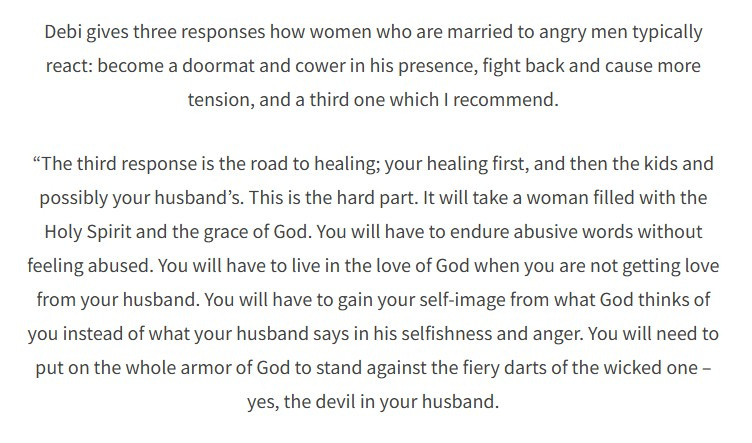
This type of advice is often followed, and many fundamentalist women will choose to “submit” to their husbands. Hoping to slowly win their husbands over with their docile and Christlike submission. “Likewise, ye wives, be in subjection to your own husbands, that if any obey not the Word, they also may be won without the word by the conduct of their wives.” 1 Peter 3:1. Actually, let’s give Lori an opportunity to explain how this might play out. Please note how the blame is taken off of the (potentially) abusive man and onto his spouse.
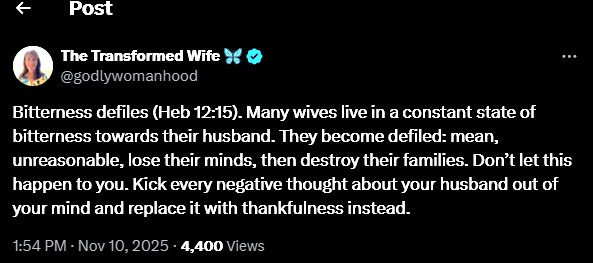
My mom lived this shit and let me tell you it doesn’t work. The abuser never changes, and the submissive partner can only bottle it up so long before it eventually spills out. And when that outburst does happen, the abuser can point to the victim as the one being “sinful.”
I said a whole lot to make very little progress in my overarching point here. But I have personally felt how Christian fundamentalism destroys people and relationships. I’ve witnessed it with my mom and my sister. And even in my own marriage relationship. This “god” prescribed plan for marriage and family doesn’t work. And it destroys lives and harms the women and the children caught up in it. No amount of outside testimony that “it does actually work” will change that lived experience for me.
While I’m glad my youngest sister has found religion as a source of peace in her life, I’ve only been able to see the extreme harm that it has caused within my family and in my own life. I hope one day she can see how much harm can happen from fundamentalism, and I hope she can break free from the cycle that is continuing to cause my family to endure abusive relationships.

 Freedom From Fundamentalism
Leave a comment. Please be kind. Commenters that come here to witness or preach will be blocked.